At the Techonomy conference in the US, Eric Schmidt, Google's boss, was saying that privacy will soon disappear and will become dangerous. "In a world of asynchronous threats, it is too dangerous for there not to be some way to identify you." he says, " If I look at enough of your messaging and your location and use Artificial Intelligence, we can predict where you are going to go. Show us 14 photos of yourself and we can identify who you are. You think you don't have 14 photos of yourself on the internet? You've got Facebook photos! People will find it's useful to have devices that remember what you want, because you forgot... But society isn't ready for questions that will be raised as a result of user-generated content."
Food for thought, and those who threaten security are surely finding their ways to locate privacy through a diligent process...
link to a blog
Saturday, 7 August 2010


Friday, 6 August 2010
Blackberry Ban In the Arab World
Blackberry phone users are edgy, will the ban in Saudi Arabia, UAE, and now Lebanon, Jordan be effective soon? The ban is about the instant messaging that goes encrypted to RIM (research in motion) the company that makes the handset devices and is located in Canada without any visibility from governments.
We all have seen the big issue of "Security" waived at us as an "encore" for limiting personal arena of freedom. Security this, security that... and what are we left with.
Blackberry was a handy tool.
But fortunately RIM was in negotiation with the UAE to collaborate with the local authority and allow encrypted messages to be unencrypted locally. There might be some hope.
link to BBC article
We all have seen the big issue of "Security" waived at us as an "encore" for limiting personal arena of freedom. Security this, security that... and what are we left with.
Blackberry was a handy tool.
But fortunately RIM was in negotiation with the UAE to collaborate with the local authority and allow encrypted messages to be unencrypted locally. There might be some hope.
link to BBC article
Wednesday, 4 August 2010
Bernard Berenson "The Passionate Sightseer"

Found in a second hand bookstore, "The Passionate Sightseer" written by Bernard Berenson and published in 1960. He was an american jewish connoisseur of art and renaissance period.
In his published diaries from 1947 - 56, he recounts on a trip to Libya, Tripoli, in May 1955. He shows photos of the Theatre at Sabratha with its great mosaic floor, he wrote about Leptis Magna and his awe at the roman ruins.
He says: "Leptis is, all considered, one of the most impressive fields of ruins on the shores of the Mediterranean and can stand the comparison even with Palmyra, the desert port, and with Baalbeck, its gigantic columns and its over-blown floreated decoration."
On the conservation in Libya, he says :" One cannot help wondering what will happen once the Allied control comes to an end. Will the Libyans want to carry on and preserve what may seem to them an intrusion from a hostile world? (...) But I hear too little of what goes on politically in this haven of peace and tranquility and cannot presume to form any judgement."
But our modern times art experts in the Arab World have enough tools to continue exploration and preservation with all western standards. It just needs the will to cherish History and stones
Monday, 2 August 2010
Big Bambu - Installation at the Metropolitan Museum of New York
 |
| photo by the Metropolitan Museum of NY |
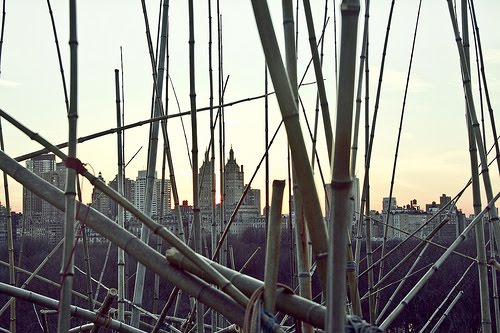
The Metropolitan Museum of New York invited the twin brothers, Doug and Mike Starn for a sculptural colossal installation on the garden roof top.
In an audio interview, they talk about their work:
" We wanted to make a living organism, not really finished, on what it means to be alive, not only on the animal level, but as a city, as a culture, it is always complete but not finished. There are lines and flow of directions while we set it up. But there is no symmetry. We created pathways within just as cities get energy from roads and pathways, we wanted our pathways to feed the installation. It is a lot of fun to walk on the bambu installation, you feel like a kid again. it is incredible with the view of the central park."
An interesting experience, and elevating on many levels: the city, the ground and the interconnections of humans and their surroundings.
Friday, 30 July 2010
Bidoun Magazine at the New Museum - New York


Bidoun magazine is having an exhibition at the New Museum in New York showing books, literature and what is published in the Arab world for the public to see, read and discover. It could another installation where one has to scratch one's brains to understand the profound sense or the meaning of it. Or it could just be an attempt to promote culture from within. But will it be in Arabic, or English books? will the English books be a reflection of the inside, or just another view of the neo-Orientalists?
It will run from August 4th to Sept 26, 2010. If you have a chance to be in the neighborhood, let us know what it is really about!
link to the New Museum
Link to Bidoun Magazine
Thursday, 29 July 2010
Rivane Neuenschwander - I wish a wish

Colored ribbons are hanging on holes in the walls, with wishes. From: I wish to be loved, to I wish to graduate, to I wish we could give back to earth what earth has given us etc... You can write your wish on a piece of paper and put it in a hole, or participate online. You can take a ribbon with a wish that pleases you and hang on your wrist with the hope that the wish will be fulfilled when the ribbon detaches.
There were two wish that were of some concern , "I wish for peace in Middle East" and "I wish for peace in Iraq and Afganistan". Wishing for peace is beautiful wish. But how the Middle East and Afganistan is the ultimate portrait of war, discrimination and abuse. Could we all wish for peace across the board, around the world? Could we wish for the end of fear to promote peace?
Link to the New Museum exhibition
Wednesday, 28 July 2010
Forensic Artist in the New Museum- New York


Have you ever heard of a forensic artist in the Arab world?
link to NYtimes article
Tuesday, 27 July 2010
The New Museum - New York

Architects (Sanaa) from japan designed it, in mind the inside before the outside, the works and needs inside the building before the outer looks.
Kazuyo Sejima and Ryue Nishizawa (the Sanaa team) are the 2010 laureate of the Pritzker architecture award, the most notorious award in architecture that gave Zaha Hadid, an award in 2004.
In the Arab world we are expecting all the new museums to start mushrooming in the UAE (from the Louvre to the Guggenheim etc) , the chosen architects were well established award winners. The next step would be to pick architects with talent and creativity and bet on their capacity to innovate, build a museum or anything and wait for the awards to be given...
The New Museum link
The Pritzker Award link
Saturday, 24 July 2010
Paige M. Gutenborg (print a book on demand)

link to Harvard bookstore
link to books on demand
Link to Bibliotheca Alexandrina
Friday, 23 July 2010
Sufi Music festival In New York

Abida Parveen, the star of the festival, has a voice in the tradition of the qawwalis rated as one of the finest voices with Nusrat Fateh Ali Khan. This festival was organized by Pakistani Peace builders who promote peace and tolerance through cultural actions. Hopefully we'll see intercultural events with the intention of peace and tolerance in the Arab world, and find ways to work along those lines.
NYtimes link
Monday, 12 July 2010
"We love words"
"We love words" is a web platform and a social networks for authors to show texts in French as a alternative to flicker for photographers, and myspace for musicians.
With a legal frame to protect authors and their rights, with a possibility of archiving, editing, creating and promoting events, the "we love words" is an interesting approach to writing and publishing.
It would be of a very high value to have such a platform in the Arab world where our main concern is censorship and political (un) correctness. Although the web is closely scrutinized by minders, but it still has a sense of virtuality far far away from reality...
link to welovewords
Saturday, 10 July 2010
Routes d'Arabie: roads of Arabia - Louvre Museum


The Louvre Museum hosts a large exhibition on Saudi Arabia, with the title : Roads of Arabia, from the 14th of july to 27th of Septembre.
With a historical backgrounds of Saudi Arabia as a crossroads to many civilizations pre-islamic and after the emergence of Islam, the exhibition will show what was left as evidence of these passages. From the Antique period to the incense caravans to the development of different parts of Saudi Arabia and several oasis's until the Islamic era to the pelgrimage roads and sacred locations.
For the small story behind the important exhibition, the newspaper "Le Monde" titled today: "King Abdallah of Saudi Arabia sulks France" (le Roi d'Arabie boude la France) and the paper gives a geopolitical explanation of why the King will not attend the opening of the "Routes d'Arabies" as a way to express his unease with the French president.
If "le Monde" is correct in its assessment, art and culture can be used as tool for nations' interest or disinterest!
Louvre Museum link
Le Monde link
Friday, 9 July 2010
Jérôme's sound system


Jérôme, in Paris, an engineer turned into a pilot for commercial planes, has a hobby: to build his own sound system from bits and pieces, wires, lamps, into an elaborate amplifier + speakers. He talks about it with the interest to track the right sound, the perfect note. He says it is all about the presence in the music and how to feel that moment.
The effect is rewarding and music becomes a pleasure.
Wednesday, 7 July 2010
Anass Habib
Will you be in Paris on the 31th of July 2010? A concert by Anass Habib at the Eglise St Eustache seems to be worth the visit! Within the "quartiers d'été" a festival in Paris, Anass Habib will give a performance.
He is known to master his voice and to use it to explore songs from the classical repertoire and from all religious range in the Arab world. He worked on the Maqamaat, to the Mouwashahat to the Mawal, to traditional music from Lebanon to Aleppo, from medieval spanish songs to poems of Mahmoud Darwich. He was born in Fez, Morocco, and has been exploring the world of music ever since he heard Fairuz in an a cappella.
link to Quartier d'été
Link to Anass Habib website
Monday, 21 June 2010
Poetry market in Paris (marché de la poésie)
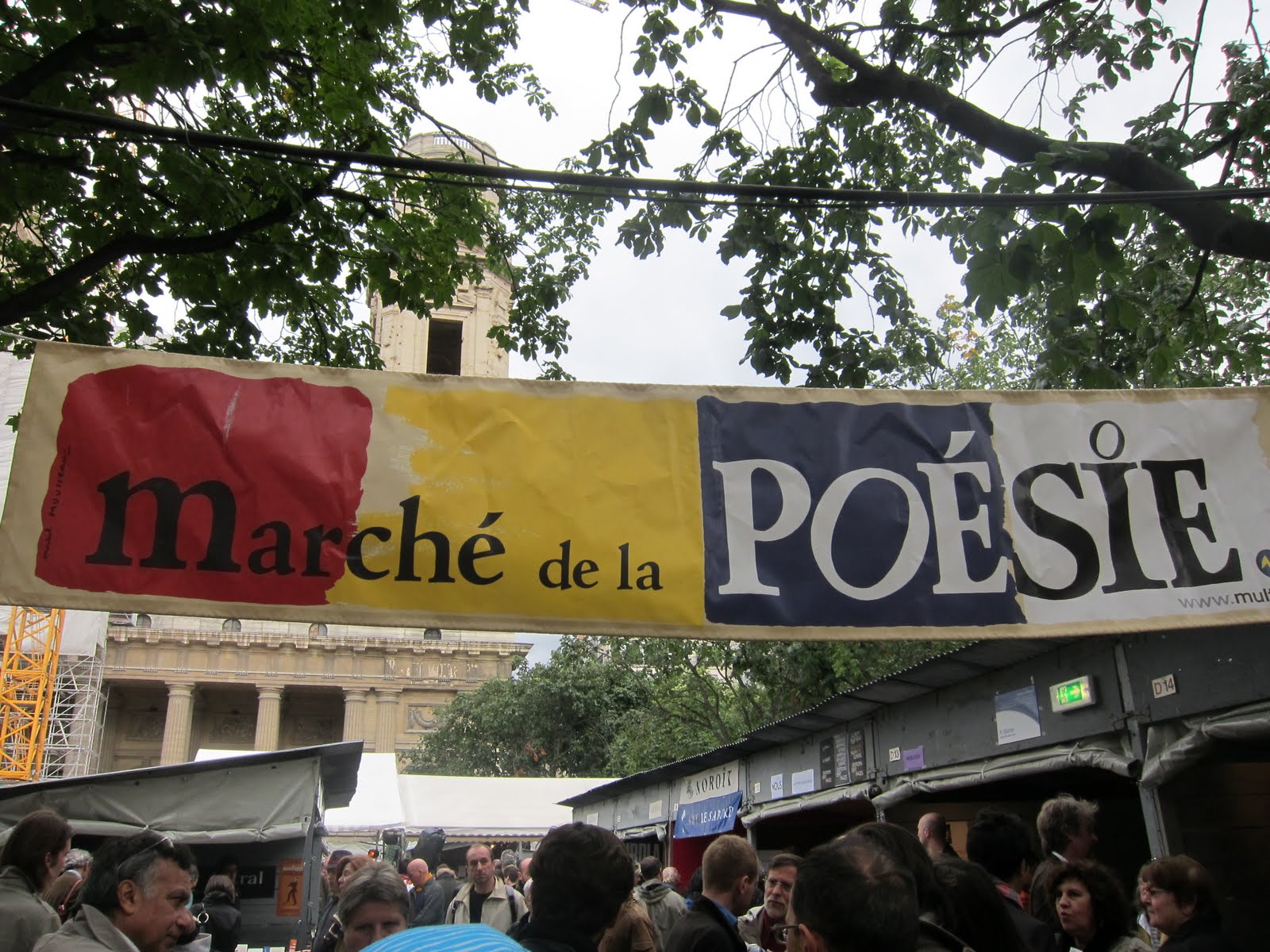

Poetry at all stands, a market for poets and poetry lovers. Words, verses, books, collections, all to use the beauty of language.
For three days (until the 20th of June) at the "place St Sulpice" in Paris, the poetry market has organized seminars, talks and lectures on poetry. In its 28th edition, the market promotes new comers in the field, new publishers and those who are well versed in the matter.
Alain Gorius has created the "al Manar" publishing house dedicated for literature from countries south of the Mediterranean. After living for quite a while in Morocco, where he established an art gallery, he went back to France in 1998 and opted for his passion of poetry, mostly arabic translated to french. The books he publishes are often combining words with illustrations by artists. Maram al Masri is one of al Manar's authors, and her latest "I look at you" is a delicate, profound book on intimacy and modesty.
Without restrictions or limitations, the poetry in his stand has a sense of freedom and openness.
Link to al Manar web site

Subscribe to:
Posts (Atom)
