Tuesday, 30 March 2010

Khalid al Hamad - photography


Khalid al Hamad, young graduate of liberal arts, fine photographer exhibited his works last week at the Boutique 4, shuwaikh, Kuwait.
His one dollar bill cut out in the geographical shape of Kuwait says something about his vision of his country or the whole relationship with Uncle Sam, or even his creative shocking interjection to get some reactions away from the common feeling of "it looks all fine, why change anything?"
His other series of young orphans in a monastery in Thailand, where he taught english for a month, is a moving series of portraits in large size. He shows that he can handle light, contrast, texture, composition.
Khalid needs to continue exploring and certainly not just getting stuck into a style because it sells. There is a lot to investigate in the world and much more to learn and share.

Agnes Stillfried - the Conquest of Tunis

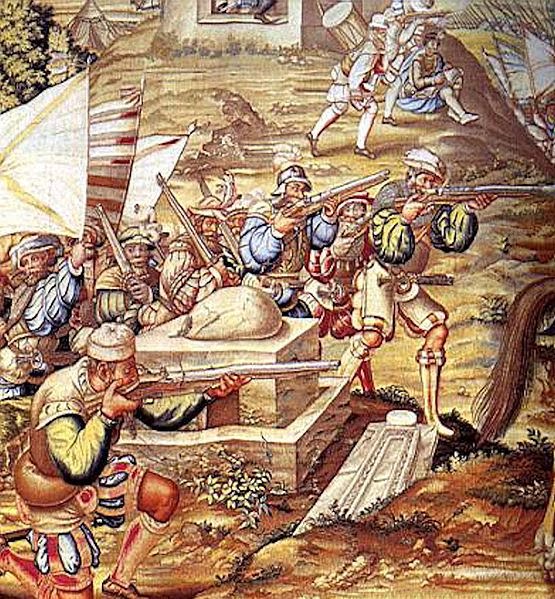
Dr Agnes Stillfried gave a capturing lecture of history through works of art. At the Dar al Athar, in Kuwait, she used Tapestry commissioned  in the 16th century by the Emperor Charles V to talk about geopolitics with the Ottoman Empire and  how battles were prepared, launched, fought, won and the final analysis of marketing one's actions.
Dr Stillfried started with some technicals on tapestry and the importance of this particular set in their massive size, woven with the best quality colors,  best material and by the best weavers.
She then exhibited the main actors: Charles V emperor, Soliman the magnificent, Sultan of the Ottoman empire,  Hayreddin Barbarossa, the pirate turned into Pasha and Admiral in control of the Mediterranean sea, Muley Hasan, governor of Tunis defeated by Barbarossa,  Jan Cornelisz Vermeyen, artist commissioned to make the most exuberant tapestry with full account of the battle,  and some other minor actors.
       Vermeyen went to the battle with the troops in june 1535 and recorded scenes in hundreds of drawings none of which have survived. He then drew the real life size cartouch, a template for weavers. These cartouch were used a first time for a set of tapestry in the 16th century on display today in Madrid at the Patrimonio National and the second time in the 18th century for another set on display in Vienna.
       Agnes Stillfried went through many details that caught her eye: like women washing on the side of a battle, or why the young page wore an oversized helmet, or the details of the Santa Anna, the largest ship of the century, or ostriches next to the goats, or the fabric and fashion of the moment etc.
      Tunis was conquered by Charles V, but Agnes Stillfried gave another historical perspective and reality: Barbarossa was still at large and ruling over the Mediterranean after his loss of Tunis and this battle did not have a significant impact on politics of that time. "It looks like political propaganda." she says. Charles V tried to market himself as extraordinary Emperor, and he succeeded, among other achievements, in leaving an artistic legacy that you should see if given the opportunity.

Monday, 29 March 2010

Diwan Shamlan - Kuwait


Diwan Shamlan is the house where the Shamlan men have received guests since 1918. The architecture is authentic, the log wood that carries the roof was brought in from Kenya and this determined the room's width. The house was built as a diwan but is not the oldest standing structure, A few other are still operating where the elderly men sit in for tea, and younger generation comes in to talk about the latest in town.
This Diwan has the distinct characteristic of history. Subjects are often about the ways of the past. The family tree is displayed as photos of those who made the family and each man carries his story. A separate special room  is meant to leave a trace of chronology where every inch of the walls show a record of Kuwait as far back as possible, from the first areal view of the Safat roundabout, to the water transported, to the pearl diving to the boats that went for months, to the people who made it happen.

The archival interest is of great value and the question remains on how can Kuwait erase its own history for the sake of making room for the new concrete towers. Today, around the Shamlan Diwan, a touristic heritage neighborhood is being built, hoping to recreate what is lost.
Will it have any soul left? Wouldn't it be better to spend money and effort to help those, with memory, preserving the fading pictures and the stories of all these events?

Friday, 26 March 2010

Broug's vocation for islamic geometrical design

Islamic geometrical figures and structures. Eric Broug is a dedicated artist that has studied extensively in the geometrical realm. He wrote books, designs objects, screens. He set up an atelier in the UK. He teaches the concept. He has a facebook page to promote interconnection about it. He is set in the world to show what a delight it can be.
        These geometrical forms are about a balance between  a grid as the necessary invisible structure and the interconnection of highlighted lines; between the limited forms and the infinite complex shapes; between straight lines and curves; between two dimensions and three dimensions and maybe even more; between the precise mathematical calculations and simplicity of visual impact; between the manifested apparent chaos in the world and the invisible well calculated composition.
There is a fascination for understanding and Broug is not alone in his quest to unlock this irresistible appeal.

Facebook page: Broug Ateliers For Islamic Geometrical Design
Broug website link

Thursday, 25 March 2010

Nabati poetry, a new tool for rebellious acts


Poetry live, from Abu Dhabi TV, on a show: "Million's Poet" a contest for the best performer. This week, on air Ms Hissa Hilal from Saudi Arabia has broken a record on her rating by the judges but also on international news about the content of her verses. She uses the "subversive fatwas" as her main rhetoric and she boldly says that these fatwas are a source of inequality and violence. She has received death threats but will appear next week on TV for the final show and will know if she will receive the big prize or some consolation money for her courage and her defiance against radical thinking.

Nabati poetry : Link


Article in The National : link

Wednesday, 24 March 2010

Music at the Palestinian Camps


Mustapha ZamZam is a singer, producer and stage performer in the Palestinian camps of Lebanon. He sings traditional tunes in a familiar beat to his audience of the camps. This particular song is about a woman, love at first sight. He searches for her from one camp to the other, asking about her, describing her. The dance performed live is the classic Palestinian dabkeh.
It is about a number one rated artist in all music stores in the camps.
Have you heard about him?
In the microcosm of the camps, the perspective of a singer takes on a whole new dimension.
It is about a historical perspective: why are there Palestinian camps in Lebanon? Which year has it started? How many generations have been living in these camps?
It has a sociological aspect: In what conditions do these Palestinians live in Lebanon? How do they go about the basics of life: shelter, jobs, medical care etc..?
It is about the one major unanswered question: what is their hope of another tomorrow?
Mustapha Zamzam takes on the role of alleviating any deep question in the realm of songs and expression of joy. Music is fundamental to humans, they use it to make life a bit sweeter and Zamzam feels like a sugar coating even if he is far from competing with Nickelback or Ragheb Alemeh.

Sunday, 28 February 2010

Caravaggio in Rome

Will you be in Rome in the next six month until the 13th of June 2010? A visit to the "Scuderie del Quirinale" is a must as they are exhibiting 24 of Caravaggio's paintings on loan from museums in Italy and abroad, many of his masterpieces in one place.
Master of "chiaroscuro"  light and shadows, Caravaggio was a turbulent artist of the 16th century. He pushed realism beyond the acceptable classical ideals of Michelangelo. He preferred to paint as the eye sees with flaws, defects and  a sense of the feeling beyond the visual impact.
To have at display all these paintings must a delight and a learning experience to the legacy of an artist and his work.

Thursday, 25 February 2010

Alfred Yaghobzadeh, at Dupon, Paris France

At the renowned photo lab in Paris Dupon, Alfred Yaghobzadeh presents his latest work as a photojournalist from 19th of Feb to 19 of April 2010. 
Born in Iran,  he was projected early on with a camera to look and see people from the natural to the awkward situations. War was a longtime favorite as he ventured in zones of trouble and danger. He covered the Lebanon civil war and was taken as a hostage during that period. He followed closely the Israeli-Palestinian conflict. From then on, he pushed through major world events from the collapse of communism to famine in Somalia, to crisis in political turmoil. His book on "christianity rites" was published as a result of an extensive coverage and research over the course of a decade. 
In his exploration to find the human side to the news, he uncovers his appreciation to life in its glorious simplicity and aesthetics. 
If ever in Paris, plan a visit for his latest work in 2009 on the elections in Iran.

Wednesday, 24 February 2010

Vintage car restoration


Khaled Kekhia has a passion: vintage cars: classic cars, muscle cars, custom cars, hot tods, race cars... He restores them, he repairs engines, he sources parts from all over the world, he gives a general maintenance to the old machines, he fine tunes delicate electrical components, he brings back the exact color with a shine, he works with leather in upholstery to match the worn out.
All with passion. He lived in the US, in California doing what he loves most. He relocated five years ago to Lebanon, found a garage and can only complain about unskilled workmanship. But he wants his garage to look like a plastic surgeon's clinic and his aides to look like Marlon Brando in the sixties. So he puts his heart in the matter and claims to "check and recheck and recheck" all the work done in his workshop. He knows vintage cars : "are like children, you wouldn't leave with them with just anyone, you need to know who is keeping an eye on them". In his shop, cars from the Gulf, Kuwait, from Europe, from local collectors are either in the air, belly up or in the plastic cover ready for delivery...

His web site is under construction but could be worth the visit soon: Classic Restoration Systems link

Saturday, 20 February 2010

Internet pushed to be a candidate for the next Nobel prize


Nobel prize is a big thing. Wired Magazine is pushing to nominate the INTERNET as a computer network to be the next peace recipient.
And the nature of this idea is so close to what we are becoming: computers, wires, network, screens, connections, wifi, messages in 140, technologies, updates, downloads, pictures, instantaneous, speed...
All of that in the name of sharing ideas and thoughts.
But have we added a fuzzy fake layer beyond our humanity to really communicate?

There is no doubt that internet has profoundly changed us. At least those who have access to it.
Wired magazine, mother of all tech promotion, was asking, if the Nobel prize goes to the Internet, who would collect the award?
Wired magazine can be the conduct of the award to give Internet Access to all who are deprived from it! That would make many satisfied: a whole industry behind the screen, and joyous innocent peers tapping on their keyboards.

Wired magazine link

Friday, 19 February 2010

Fritzi Metzger's carpet

At the JAMM auction in Kuwait, the work of Fritizi Metzger was exhibited but not for sale. It was a collage of photo prints on canvas, in a large scale. "I wanted to make a carpet out of the photos I took from my small camera in Lebanon." said Fritzi who plans to produce carpets from all her Middle East destinations as a souvenir of the places she visits. Quite an interesting piece with great details and good overall perspective.

Auction in Kuwait


On the 17th of Feb 10, JAMM offered sculptures and paintings  from artists from the region and the Gulf for sale at an auction in Kuwait.
"La creme de la creme" was all dressed up and ready for the event, from the preview with latest cocktail dresses to the little black dresses on the auction night. Collectors, wannabe collectors, new generation collectors, special theme collectors, and collectors who have Warhol on their walls since the seventies were side by side with art specialists of the region, art consultants, art gallerists, art journalists and art "enthusiasts".
They all had small paddles, hands with numbers, to signify their desire to pay the price.
But the auction started, led by Ms Aileen Agopian, Director of Contemporary Art, New York with minor technical sound interferences. And when it started, each on his own experienced the thrill, that buzz of silence. Few questions had to be answered: do I really want that piece, how far can I go, is it worth the price? etc...
The highest sale was the painting/video "the Rabbits" by Farideh Lashai: at 37 000 usd. Very pleasant to own, the video projection on the paintings of rabbits roaming is a new twist of Lashai's work. 
The next best sale was also by an Iranian artist, Rokni Haerizadeh at 31 000 usd. Then comes the lucky Kuwaiti, Shurooq Amin who's work sold at 28 000 usd. 


Many of the 50 art work were of very good quality even if their prices have not translated into the top rated. It is the matter of fact in auctions, works don't necessarily relate to the best quality but to that desire to buy, pumped up by fierce competition.
There has been a few auctions in the past in Kuwait of smaller scales and lesser marketing tools. JAMM could be the next in line to promote art in a glamorous manner. Auctions have to become more institutionalized and formal to really influence the art market in Kuwait. Let's wait then for the next one!

Wednesday, 17 February 2010

Censorship part 2

Dr Thomas Modeen, fellow blogger in Kuwait, shares some of his experience about censorship while teaching at Kuwait University.
please read excerpt of his blog entry on censorship:

"Today I was informed that the project exploring censorship in Kuwait (featured earlier in this blog) has provoked an angry reaction by some of the powers that be at Kuwait University. I apologise for that, the intention with the project was never to cause offense - its aim was to explore a particular aspect of Kuwaiti culture which, particularly in the context of various art and design related practices (particularly within graphic design, the major of all the students in the class) is of significance.

However, beyond the fact that I feel it's a bit of a storm in a tea cup (as, after all, even the included images are 'censored', albeit in a different manner than what can be observed at local news-stands), if this type of benign exploration and research can't take place in academia, within the confines of a university (amongst the brightest of bright in the nation), where can they?"

Read the rest  at his blog: Kuwait School

and take the time to read comments.
It seems Dr Modeen is leaving Kuwait for better prospects elsewhere.
Quality is rare in this country, opportunities so often missed and usually for the wrong reasons.

Sunday, 14 February 2010

Censorship


 Censorship and auto-censorship is a deep conditioning in the Arab world. We get used to it, we live by it, we abide by it, we move on with our lives without thinking about how much is censored and how far can censorship affect us.
Then in Paris, France, the Minister of Culture, Frederique Mitterrand, pulls a stunt and makes a stand against censorship.
The famous "Ecole des Beaux Arts" was established in the 17th century and has kept up with the highest standards of education in all forms of arts and very demanding classwork. This week, they had sponsored an exhibition by their alumni students and Ko Siu Lin put banners on the outside walls of the institution. She did not use sex, drugs or illegal substance for her works. It was just four words : travailler - moins - gagner - plus (work - less - earn - more).
She used the French president's slogan (work more, earn more) used during his election campaign. She deviated the words and the meaning. 
Her work was censured and removed. 
Then the Minister of Culture decides it is not the way to be, and summons the banners to be put up again.
Now why would he do that?
Why not accept, like all of us in this part of the world,  that if someone is offended and he's in power or gaining influence, we should just apologize and remove our dirty filthy thoughts from our brains. 
It takes courage to make a stand on freedom of expression. 
It takes audacity and bravery to make a stand on freedom of expression.
And we have none of that in the Arab world.

Monday, 8 February 2010

Mohamed Yunus, editor in chief for a day


Interview de Muhammad Yunus
Uploaded by liberation. - News videos from around the world.

Nobel peace prize of 2006, Mohamed Yunus is an advocate of social business, micro-credit as way to alleviate poverty. He was invited by "Liberation", a french daily newspaper, to be their editor in chief for a day.
The exercise is quite innovative: to invite someone to interact within a media company responsible for providing reliable information. It is also a way to give another angle to the usual thought process.
He was interviewed on his views of the microcredit process and he talks among many issues about future generations.
He founded Grameen bank, in Bangladesh, in the mid 70's, as a way to break the cycle of shark lenders who charged abominable rates to the poor putting them in an never breaking debt series. He started with small amount of money, and build a system around collaboration, proximity, trust, empowerment. He found women more reliable to repay their loans. He helped many in his country and around the world as his model was reproduced everywhere, even today in the western world such as in the US or in France.
His main critics believe that the only thing he promotes is capitalism as the only way out of misery.
But his conviction in helping others has made him a man of action, opening the eyes to the underworld of poverty. Traditional banking can no longer only focus on profit for high net worth individuals. It is time that all those who access capital, such as countries in the Gulf, to share with smaller financial institutions their knowledge and capacity in this struggle.

Grameen Bank link
Liberation link