Sunday, 20 February 2011

Kuwait Auction - JAMM - Abdel Aziz al Mudhaf

Abdel Aziz al Mudhaf 's painting was sold during the JAMM auction in Kuwait. He's a young artist just graduating from American University in Kuwait.
His art is daring, bold with a cry of expression beyond the pain and repressed feelings. It was one of the few works that went beyond the decorative and expected.
He has produced in the same theme some works exhibited in Kuwait and in Dubai.
The buyer of this artwork must be a courageous collector and an audacious believer in supporting emerging artists. 

Friday, 18 February 2011

Auction in Kuwait - JAMM- Fareed Abdal


Interview with a Kuwaiti artist, Fareed Abdal, during the auction in Kuwait.
Fareed is an architect, professor, artist, photographer, jewelry designer and has many unspoken areas of interest... His artwork was sold at the JAMM auction of this year.

- What do you think of this auction in Kuwait?
"Any activity that can unleash creativity in our society is a good activity. It allows us to develop visual depth. We all have subjective opinions on what art should be, who is an artist and how should he be. Whether the artist is young or older, starting now to create or have a track record and maturity in art; It doesn't really matter.
The artist is listening to his inner journey, he will not be fooled by judgement of others. It is better if the art is celebrated but artists have their own story to be told.
There might be a need to have a more rigorous judgement and critique.

- How do you sparkle creativity in younger generations?
"Art is a form of meditation, a contemplation and reflection. It is the necessity to share each's point of vue, his angle of life and each is different. Practice often becomes the theme and becomes an obsession. Anything will be a source of sparkle...
Matthew Fox said: "Do not confuse beauty with beautiful. Beautiful is a human judgment. Beauty is All. The difference is everything. "

- Does Kuwait need an auction house, is there not enough galleries?
" I could build assumptions and see the negative side of auctions as it is known worldwide: It's like a stock market, you raise prices of shares and promote speculation.
The good side to an auction is bringing an understanding about the culture value. The value of a painting is different from its cost. Kuwaitis are sophisticated buyers in business and they are well aware of cost in many things. But the added value of development, of an extra mile or an extra artistic input is not yet appreciated. The power of aesthetics is an added value.  It is a new language of creativity and this auction will trigger debates about prices, value, added value, creativity.
That is quite healthy
We need to increase the number of people who recognize the added value.

- Is there a culture of auctioning in Kuwait?
" Not in the visual art maybe, but in our own history and culture we do a lot of auctioning, from the fish, to camels, to goats, to cars.. these are commodities and objects.
Historically, we even had  auctions on appreciation of beauty with arabian horses solely about aesthetics and beauty, so different from warrior, race or work horses.
So yes, we do have a  culture of auctioning in Kuwait in all of its meanings...

- What was behind your art work for sale in this auction?
" It's a work of calligraphy of a Quranic verse, but I like to flirt with the Sacred and the Holy and see what comes out of it. I confront the verse against other religious frameworks, against water on paper, against the structure and the imposition of a framework by preconceived ideas of sacred. I see the universal everywhere and I am part of the Divine's creation as equally as anything else."

- Nearly all works have been sold, is it a successful auction?
"I measure success not by sales but by the intention:
The auction is donating a percentage of the profit to a charitable cause: "Bayt Abdallah" a hospice in Kuwait for children with life threatening diseases, open to any child in Kuwait, regardless of origin, nationality or religion.
This cause celebrates every moment of life, to help out children in distress.
I find it special and different from other auctions, artists are part of collective effort to help out. and that is beautiful."


Saturday, 12 February 2011

Auction in Kuwait - JAMM - year 2

JAMM keept its promise after last year's auction in Kuwait. This year's auction was in a another venue, but the art displayed and sold through bidding was of equal quality if not more prolific.

For the event of the 9th of February 2011, JAMM selected around 90 art pieces, from paintings, photographies, sculptures, neon installation etc...

Artists came from Kuwait,  the Arab world, Iran, Turkey, and western countries. Some of these artists are just starting their careers, others are well established in Kuwait and out of Kuwait, some have a long history of recognized works.
Subjects had the classic calligraphy, modern calligraphy, political art, icons in theArab world, icons worldwide, classic Kuwaiti scenes and many more...
The eclectic choices showed an understanding of how the local market will react.

Pieces like the Damien Hirst prints were not perceived as a hot buy and did not make the expected high numbers. Art Critiques were saying that the market in kuwait was not a speculative one, they don't buy to resell and make immediate profit. They seem to need an emotional connection to the pieces they bought.
Overall, the experience was worthy of all the efforts.
Next year will hopefully be even better.

Thursday, 10 February 2011

Rap in Tahrir Square - Cairo by Dia al Deen


A video clip in a rap style: The lyrics are simple but they express needs of the Egyptian street , going well with the Nile revolution.
" We live like cockroaches ...
This is the meaning of Freedom,
and it tastes better with Mouloukhia ...
Do you see the disaster in our lives
Everyone turns his back
and prays God to be spared ..."

Rap makes sense with the demands and discontents of the people. The Tahrir phenomena is a wave spreading. The Arab world is holding its breath waiting for the outcome and wishing for the best to be achieved.

(Thanks Abdullah for posting the clip on your facebook page)

Saturday, 5 February 2011

Hang in there 248am - blogger gets a lawsuit for an opinion


The Arab world is boiling with turmoil, masses are asking for change, freedom, liberties, opportunities. In Kuwait besides the concours d'elegance and the preparation for the 50th celebrations of Liberation day, a blogger, Mark, in his popular blog: 248am, receives a lawsuit for posting his opinion on Benihana, a newly opened restaurant in Kuwait. He did not really like his experience.

Do you mean if one talks about anything negative, they will be immediately persecuted?
And this is not a political opinion, or a dissent's reaction, or a voice calling for justice or a repressed group in some underprivileged conditions.
This is just a restaurant, food, and marketing.

Well, fellow blogger, Mark, hang in there. It can only show how powerful you have become in your opinions and how important your views can be.

There is a lot of talks about the importance of Facebook or twitter and virtual communities in the making of these street revolutions.  The power of opinion, once it's heard by a larger group, can have a huge impact.
We'll be waiting to see the lawsuit's evolution and Benihana's survival.

248 am link to blog


Concours d'elegance - car show - Kuwait


photos by "concours d'elegance"
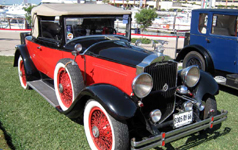
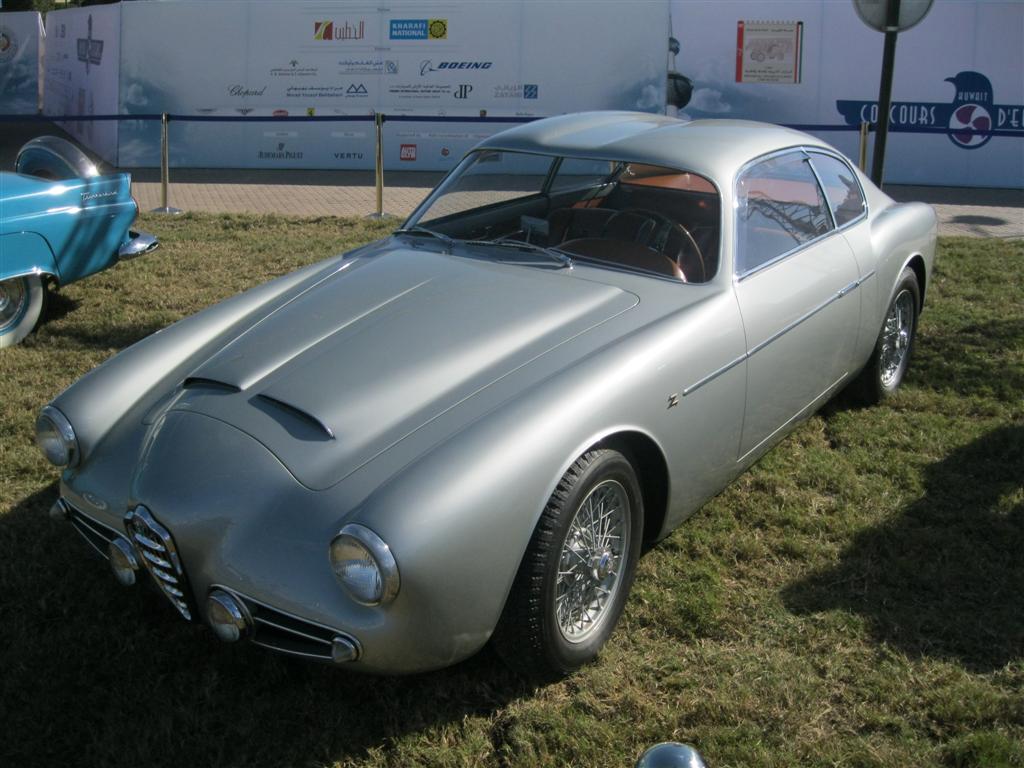
For the second year, Kuwait hosts a "Concours d'elegance" for vintage cars, in the Marina Crescent, Salmiya.
"Some of these cars are sculptures" says a viewer as he took his family to see the beauties on display. Some cars were flown from Japan, from the US, from all over the world. There is a jury of 16 experts on the matter. There must be a grand prize after the show.
But the real pleasure is the idea that Kuwait celebrates history. When it opens up it doors for old machines, labels them with the term "elegance", it gives an opportunity to value historical way or the old way of doing things.
For a country so geared towards the new and the latest in all technologies, it is reassuring to see that there are local oldies, polished, waxed, cleaned in their best attire.


link to the website Concours d'elegance

Wednesday, 2 February 2011

Stefan Weber - Berlin Museum

Aleppo room

Ishtar gate
Stefan Weber, orientalist and director of the Museum of Islamic Art in Berlin, Germany, gave a lecture in Kuwait at the Dar al Athar al Islamiyah. The title was obscure:" Fragments of a lost Past or evidence of a connected History: the role of urban artistic heritage in the new conceptualization of the Museum of Islamic Art in Berlin".
It sounded convoluted, introverted study of unknown objectives.

Dr Weber pulled it off quite nicely and gave a historical perspective of the museum itself, with dynamics and thought process behind it in the 1920's and the 1930's. He explained the evolution and reasons behind a museum and the evolution of objects' presentations. As the museum is expanding in another wing, he shared briefly the process of making a new space.

He talked about how historically objects and architecture were not isolated but interconnected through time, space and in relation to global trade and movement of artisans. He referred to what Yuka Kadoi was lecturing on few weeks ago: "the Islamic Chinoiserie"or how China influenced Iran in productions of art and objects. But he had a more assertive tone and did not seem to question at all the evidences. He showed the phoenix and the dragon, symbols in China, on metalwork produced in Iran. For him, it could have been imported as a symbol, but after a generation, it was totally integrated in the culture and fashion thus becoming part of the local consciousness.

It seems like a new trend to integrate art history in a context and expand it, rather than isolate objects and art history in its own frame.

In the new Museum, he explained that objects will be displayed according to three parameters: of course chronologically, then geographically, and last, in relation to how and where these objects were used.

Have you been to the Islamic Art Museum in Berlin? Hurry then! They have treasures, and they have directors passionate about their work.
Dr Weber said:"When I got my job at the Museum, I was so happy I could see the Aleppo room and all its woodwork at all times, it's my favorite..."


Monday, 31 January 2011

What to wear on a revolution - Amani Massoud

What to Wear on A Revolution - Amani Massoud  LINK

Shake the standards, write with wit, and get a reality check on what is happening in the streets of Cairo. A new web portal / blog "Mashaallah" recently activated, publishes quality, journalistic reports.
Amani Massoud starts off the revolution with a cynic's perspective. She accounts as someone who would like to continue life as usual and yet is compelled to participate in something bigger than her. "Accordingly, I left home that day with very little expectations, determined not to take part in what I had already decided was a failure," she says, "Two layers, of not so loosely fitting pants, layers of light sweaters…nothing too low, and comfortable boots. That’s what I wore for the revolution. Nothing that gives way to sexual harassment or a chance to have your clothes pulled off..."
The full story is a good read to follow what's happening in the Arab world's public scene. 


And the title "what to wear on a revolution", is actually a profound question. It gives a direction in which the revolution might go. We'll see if women are participating, we'll see if their attire is one of freedom or one of restrictions, we'll see if women will take their places in times of change.

If the fires catches up and the wind blows beyond borders, fashion could be a good measure of where it will all go...

Mashaallah blog


Saturday, 29 January 2011

"Power point makes us stupid" - Franck Frommer

The word is out since the US military is strategically thinking of  Power Point's (ppt)  impact on winning or loosing a battle. (see NY Times article)
In France, Franck Frommer, a former journalist and a specialist in communication, has been studying the matter closely for the past two years and produced a well documented research. He says ppt is a good tool to make many presentations, but why has the world of communication been highjacked by powerpoint and the only way to communicate and present any idea has to go through that box?
He is surprised at how the whole world is thinking now in slides, one thought per slide, with limited visuals. His worry is the lack of creativity in the process. He defines thinking through Powerpoint as intelectual poverty.
Food for thought: do you feel that ppt is making you stupid?

link to Entrecom's blog in french

link NY Times

Sunday, 23 January 2011

Oleg Grabar


Oleg Grabar passed away on January 8th, 2011. On the review of the Aga Khan's architecture awards, this blog had not mentioned the Chairman's award given to Grabar as a tribute to his work on Islamic art and architecture. 
In his speech in Doha for the awards, and as his last public appearance, he says :

" It is with much pride and gratitude that I have accepted the Chairman’s Award from the Aga Khan Award for Architecture, following Hassan Fathy, Rifat Chaderji, and Sir Geoffrey Bawa. It is an honor to join such a distinguished company and, even more so, to be the first one who is not an architect nor a planner, not even a decision-maker (...) but an academic scholar and teacher who has spent his life in universities and research institutes learning and then transmitting to others, in lectures, seminars, and writing whatever I had learned and understood. And it is with these two themes of knowledge and of education that my remarks will deal.
(...)
(...)
These are all developments that could have made all of us richer and more sophisticated in our understanding of the vast Muslim world. But have they done so? Not always. In a paradoxical way, they have strengthened parochialism, because few thinkers, practitioners or generalists are really involved in imagining what Morocco, Uzbekistan, or Malaysia have in common. It has become easier to firm up one’s own rather than to drown it with too much parallel information. This development is clearly tied to the rise of local nationalisms of all sorts and may not subside, but national passions are so tragically inbred in men and women that I can only hope that the global humanism I wish to preach is not a dream. Then, the rise of violent extremism among Muslims and a destructive and senseless response among non-Muslims have led, for our academic and practical purposes, to an almost paranoiac concern for security and to restrictions on travel or on exchanges of all sorts which are harmful to the growth, even the maintenance, of learned connections and of a fruitful knowledge. Behind both extremism and the response to it lies a profound ignorance of everything, from the interpretation of religious texts and awareness of history to the beliefs and motivations of others than ourselves.
These are all rather frightening prospects, especially when it is so easy to draw a vision of a rich and productive future, in which local creativity can enhance the lives of all men and women and become known to all of them, from financial or political leaders to schoolchildren. People of my age will not know whether this vision will ever become real, but we all know that those here and elsewhere who are under fifty have an exciting challenge ahead of them, and, thanks to the Aga Khan Award and to a number of parallel institutions, one or more vehicle to meet that challenge."

Those under fifty, (or just around fifty...) do hear out the wise man in his wishes: "you have an exciting challenge ahead of you... "
the "global humanism" has been dreamt of  and can be achieve, here and right now, by those who hold the future in their hands...


Friday, 21 January 2011

Kite flying in Kuwait


Did you ever hear the swooshing sound of the wind in a large kite?
On a crisp clear day, kite flyers of Kuwait gather at the Messilah beach and enjoy the art of flying kites.
They bring their treasures with ropes, weights and spend the day on the beach for the pleasure of a floating experience, eyes on the sky.


Sunday, 16 January 2011

Yuka Kadoi- China/Iran interaction during the Moghul period

At the Dar al Athar al Islamiyah on the 12th of january 2011, in a surprise, unscheduled lecture, Dr. Yuka Kadoi gave a talk on the interaction between Iran and China during the Moghuls period in the 13th c. ad.
In a poised manner, she introduced many flamboyant ideas about art and history.
She covered many areas and objects from ceramics, to metal works, to miniatures. She, then, showed the evolution of the artisan's works and influences form China, through the Moghuls. She also stated that China, being as conservative as they were could not have been influenced by Persian artists. She compared europeans of that period being only on a one way mouvement and islamic chinoiserie being a fruitful admiration with fundamental interactions.  She tried to question the reason of having a lotus flower in the decoration of a metal bowl in Iran under the Moghuls when in China, lotus is a symbol of Buddhism. She showed pictures of figural images in manuscript, how before the Moghul invasion they were two dimensional and after the Moghuls, they had perspective, depth, and a better feel of space and height.
It is quite a narrow angle of looking at history.
But she added that interaction were limitless when the trade flourished through the silk road or maritime routes for a long time. She said that ideas did move, and there has been an interaction from east to west before the invasion of Iran by the Moghuls. Nomadic people, skilled artisans moved across borders and frontiers, and they brought with them teachings without restriction.
She also stressed on the need to enlarge the definition of Islamic Art, since it is not only one style and one block, and fade away from the obsession to find one absolute version of islamic art.
She talked about paper trading from China at that time and how that trade had influenced a much larger and wider production of manuscripts.
Are we not still trying to understand the impact of trading with China on our culture and art? are we not still trying to define islamic art in an absolute, pure term or rather in a contemporary, interactive way?
Debates are open and scholars help us search for answers.

Friday, 14 January 2011

A photographer in the Sartorialist


The sartorialist:
(definition of "sartorial": adjective: of or relating to tailoring, cloths, style of dress: sartorial elegance)
A photographer, Scott Schumann, is interested in fashion, cloth and people who carry well what they wear. He takes photos on the streets of New York, Milan or Paris. He also takes photos of highly visible and known people in the fashion industry. He shows his works on a blog: The sartorialist.
Up to that point, it all seems pretty typical of anyone who has a passion and exhibits his views on the web through a blog.

In that video though, there is one fascinating attribute: the look on his eyes. Schumann is metamorphosed when released in the wilderness.
He becomes a tracker, he maneuvers as a hunter, he detects details, he identifies a look, he spots grace, he catches a style, he captures the effort of refinement.
Then, quickly, in a few seconds, it's over: pictures are taken and he's back on the tracking lane, without respite. Everything, everyone can become a prey.
And he remains an agile hunter, moving, determined to track, no matter how many images are in his memory card, or his actual physical memory. There is no end to it.

link to the sartorialist

Monday, 10 January 2011

Monet in Paris

"La Pie" - Monet - Musee d'Orsay - Paris
Monet is a classic in Paris, or for a visit to his house outside Paris in Giverny.
A huge retrospective of his works will be shown at the Grand Palais until the 24th of jan 2011.
It is a delight and pleasure.
But if you can't make it, do consult the website for the exhibit: it is as pleasant as his work, and a real treat to browse through.
link to website

Saturday, 8 January 2011

Bulgari - Italian Jewelry at the Grand Palais, Paris


photos by Bulgari for the exhibition


Bulgari carries 125 years of finest jewelry making. An exhibition at Grand Palais in Paris until the 12th of january 2011, shows archived pieces of Bulgari but also privately owned pieces that could not be exhibited otherwise.
If you have any interest in the art of jewelry, do not miss an opportunity to see how it was made historically and how it has evolved through new technologies and the market's demands and desires.
Bulgari remains a symbol of class and good craftsmanship.
link to the Grand Palais