Saturday, 18 December 2010

Agha khan Architecture Award - Revitalisation of the Recent Heritage of Tunis


The last of the five projects awarded by the Agha Khan was for the revitalisation of the Recent Heritage of Tunis, spearheaded by the Association de Sauvegarde de la Medina de Tunis (ASM).
It chose to look at recent buildings form the 19th and 20th century and consider it as valuable although it has a diversity of styles, form art deco, to art nouveau to pastiches of classic.
There is a fundamental questioning on what is old, how old is old and why do we need to value it, to restore it, to preserve it, to revive it.
What does history gives us?

In Kuwait, there is another type of relation with old buildings. The general trend forgoes the past: New is better as old is a reminder of difficult times. A committee is trying to work on preserving old buildings, some individuals choose to live in old houses. But it might be too late!

photos by the Agha Khan Awards for Architecture

Friday, 17 December 2010

Sunny Art Fair in Amman - Jordan


Until the 18th of December, Amman is hosting the first contemporary art fair in Jordan. Great initiative, specially that efforts in the art world of Middle east are usually focused on locations where the buyers are more than where the artists produce.

Selection of artists and local gallery show a depth in works and maturity in the productions.

The lectures and the debates have interesting titles and could be of value.
It must have been a magnet to attract art lovers and connoisseurs away from the other event concurrently in the region "the opening of the Mathaf", the New Art Museum in Qatar. Sure, the Qatar event made the headlines of CNN about nudity and controversy. However the Amman show is a real live interactive production!

link to the Sunny Art fair Web site

Wednesday, 15 December 2010

Agha khan Architecture Award - Ikepoyl textile factory in Turkey


The next Agha Khan Award for architecture was given to the Ipekyol textile factory in Turkey, Erdine, west of Istambul at the edge of the European frontier. The corporate group chose to invest in good, well thought of architecture with design by Emre Arolat and build a pleasant environment for workers and staff to produce better.
Space, light, recreation, cafeteria, all the elements needed for the employees are provide. The staff is not even in the creative realm, they are behind their machines, producing women's cloths on a production line. Now that is an interesting thought for the underdeveloped world, filled with sweatshops and dirty dark factories.
The whole atmosphere might be overboard for what a textile factory should or need to be. Did anyone look at profits, margins, returns on investment? They must have: Ipekoyl is brand with a vision and targets to be on the top of their market. If you ever find an Ipekoyl store during your travels: remember: they value details down to the architecture of their factory so their cloths must be worth looking at!

(photos by the Agha Khan Awards for Architecture)

Monday, 13 December 2010

Agha khan Architecture Award - Madinat al Zahra Museum Spain


The next Agha Khan award for architecture was given to the Museum in Madinat al Zahra, Cordoba, Spain. It was completed in 2008 and designed by Sobejano Architects, Fuensanta Nieto and Enrique Sobejano. As they have said: “ We took the foot print of three ancient city and incorporated a new building around it. It is a relationship between contemporary architecture and the historic city, more of dialogue.”
A clean cut feel, with white cement walls. Simple but vast in its volume and space. Patio and courtyards intergrate all the light possible.
It is always a bet and a challenge to be so contemporary. The real judge will be the surviving effect of time.

photos by the Agha Khan Awards for Architecture


Sunday, 12 December 2010

Aga Khan Architecture awards - Wadi Hanifa in Saudi Arabia


The next Agha Khan award for architecture was given to the wetlands of Wadi Hanifa on the largest river next to Riyadh
Over 120 km, the Wadi was a dump, neglected for decades. The authorities decided to implement a change. With the help of  Moriyama & Teshina planners from Canada and Buro Happold, the Wadi since 2001 is on a rebirth mode. Alive.
The wetlands were designed to become a recreational area, it allowed the enhancement of agricultural land, and it has biological treatment plant to purify the water.
If all dumps were turned into gardens, would that make planet earth happier?


Photos provided by the Agha Khan Architecture awards
Link to the website

Tuesday, 7 December 2010

Agha khan Architecture Award - Bridge school in China


An Agha Khan award was given to a chinese Architect, Li Xiaodang for his "Bridge school" in Fujian province in Xiashi, a village crossed by a river.
A bridge school is simple steel structure over a river. As Xiaodang says: "minimum intervention for maximum impact". The aim was to rejuvenate the village, give a new breath to the tiny primary school. On a 200 sq meters, the school can be totally opened up or sealed up. Wood is the material used for the surface, a sustainable and easily replaced medium. The school of two classrooms has become a playground for the kids.
That looks like a creative solution for low cost and effective architecture for the future.

Wednesday, 1 December 2010

Dance Africa Dance - festival in Bamako Mali

LINK TO a France 24 report (8min 39')


Dance Arabs Dance,
Enough of talking, arguing, attacking, revolting, justifying, victimizing, repressing, censoring, suicide bombing, destructing...
Take a look, Arabs, at our brothers in Africa during the dance festival in Bamako.
Learn
And get down to business:
Dance Arabs Dance

Monday, 29 November 2010

Sophie Budden, Conservateur at Dar al athar al Islamiyah

During a lecture at Dar Al Athar al Islamiyah, Sophie Budden talked about her job at the al Sabah Collection, covering more than 22 000 objects. With a wide range of pieces from fabric, to carpets, to metal, to stones, to manuscripts; and from different eras, to different provenance, Sophie was talking about her aim: general care, cleaning, storing, finding,  packing, exhibiting.
It all sounded quite thrilling.

She showed pictures of before and after, she showed how meticulous the work had to be done, how precise scalpels under microscope took 4 to 6 weeks to clean a metal object to restore and give it a shine. She had a higher pitch of voice when she tried to convey her excitement on how it was "terribly neat to look and find what you want" through the custom made data base for the collection or through the endless storage shelfs. She mentioned "vigilance" as a time consuming effort for keeping the objects safe from humidity, from moths...
She shared her amazement after cleaning a silver enamelled sword, the exuberance of true minuscule carving showed and how the movement of luminosity is reflected and refracted

It seems that Sophie Budden has an incredible mission: Civilisations disappear, people die, and she fights the time machine to protect the precious objects from going back into dust.

more on the lecture at the DIA blog link

Saturday, 27 November 2010

The Chandayana by Dr Naman P. Ahuja

Dr Naman Ahuja, from the Jawaharal Nehru University, in New Delhi,  loves to tell a good story and the "Chandayana" is a good story. During his lecture at Dar Al Athar al Islamiyah he tried to push for a scholarly presentation of styles of painting miniatures on paper (the Mandu style, the Jain style, the unique style, the Chaurapanchasika style...). He tried to explain how a folk tale was hijacked by the sufis to turn into a religious message of seeking and looking for divine intervention. He tried to explain the shift from an oral tale to a written script, and to underline the importance of epic indian codes of symbolism.

But when he stood there and said: "She swoons, their eyes met!" with a pause. It became vibrant, alive. As if he was Mullah Daoud in the 14th century, keeping his public alert, gasping for more. And the story of Chanda goes on with love, beauty, honor, loyalty, tourment, separation, exile, husbands, wife, mothers in law, battle, armies, fakirs, yogis, deities, and supreme love yet unbearable to many.

Dr Ahuja gave a pulsating lecture and it remained informative and enriching on all levels.

For more on the story of Chanda DAI blog link

photo :The Heroine Chanda fanning her beloved, Laurak, under a tree, from a manuscript of the Chandayana (The Story of Chanda), 1540
Pigments on paper
(SanFransisco Asian Museum)

Friday, 26 November 2010

Aga Khan Architecture awards in Qatar

Every two years, since 1977, the Aga Khan Awards for islamic architecture selects projects as recipient of the famous awards and gathers all the attention on the subject. On the 24th of November this year's ceremony was held in Qatar.
Please find a few extracts from his Highness the Agha Khan's speech:

"Many of you will remember my personal concern, back in the mid-1970’s, that this conversation was scarcely even taking place.
Discussion and debate about the built environment in the Islamic world was then a very thin proposition. The continuity of Islamic architecture had sadly lapsed - weakened by the heavy hand of colonialization, by modernization and globalization, by the lack of architectural training in Islamic contexts, and even by the development of new construction materials in the industrialized world. The result was a paucity both of indigenous architects and of foreign architects working with distinction in Islamic settings and idioms.
Historically, the arts, including architecture, have taken their principal inspiration from religious faith. But when art is separated from faith-based roots, other influences can dominate - including soulless technology and empty secularization.
At that time I used the term “vacuum” to describe the Islamic architectural scene. The initial goal of our Awards programme was to replace that vacuum with an energized debate.
Why should we emphasize an Islamic approach to architecture? Our Master Jury, in responding to this question, has described how global forces now threaten the values of “memory, heritage and belonging,” and how the built environment can help meet that challenge.
At the same time, in looking at the places we have met and the projects we have honoured, we also see enormous diversity. Diversity, in fact, is part of the essence of Islam. 
Nor does respecting the past mean copying the past. Indeed, if we hold too fast to what is past, we run the risk of crushing that inheritance.
The best way to honour the past is to seize the future.
These, then, are four of the major concerns that I would submit for further discussion. What does architectural excellence mean in the context of Islamic traditions and aspirations? How do we reach a wider array of constituents? Can we expand our social and economic relevance? And how do we best employ innovative technologies?
These concerns, of course, will lead us to further questions. How and where do we teach about architecture? How can we anticipate and occasionally help steer the processes of change? How do we best reward and learn from those who are most successful? How can we share our lessons with others outside the Ummah?"

In the next few posts, the 5 recipients awarded will be presented in this blog
If you are impatient, visit the Aga Khan Website for more on all these wonders:

Thursday, 25 November 2010

Resuming blogging

After a long freeze in the desert, nearly 4 month,  blogging is ready to resurface.
Ready or not, here it comes!


(Thanks Abdallah for the comic strip!)

Saturday, 7 August 2010

Eric Schmidt: "Privacy? too dangerous"

At the Techonomy conference in the US, Eric Schmidt, Google's boss, was saying that privacy will soon disappear and will become dangerous. "In a world of asynchronous threats, it is too dangerous for there not to be some way to identify you." he says, " If I look at enough of your messaging and your location and use Artificial Intelligence, we can predict where you are going to go. Show us 14 photos of yourself and we can identify who you are. You think you don't have 14 photos of yourself on the internet? You've got Facebook photos! People will find it's useful to have devices that remember what you want, because you forgot... But society isn't ready for questions that will be raised as a result of user-generated content."

Food for thought, and those who threaten security are surely finding their ways to locate privacy through a diligent process...


link to a blog

Friday, 6 August 2010

Blackberry Ban In the Arab World

Blackberry phone users are edgy, will the ban in Saudi Arabia, UAE, and now Lebanon, Jordan be effective soon? The ban is about the instant messaging that goes encrypted to RIM (research in motion) the company that makes the handset devices and is located in Canada without any visibility from governments.
We all have seen the big issue of "Security" waived at us as an "encore" for limiting personal arena of freedom. Security this, security that... and what are we left with.
Blackberry was a handy tool.
But fortunately RIM was in negotiation with the UAE to collaborate with the local authority and allow encrypted messages to be unencrypted locally. There might be some hope.
link to BBC article

Wednesday, 4 August 2010

Bernard Berenson "The Passionate Sightseer"


Found in a second hand bookstore, "The Passionate Sightseer" written by Bernard Berenson and published in 1960. He was an american jewish connoisseur of art and renaissance period.
In his published diaries from 1947 - 56, he recounts on a trip to Libya, Tripoli, in May 1955. He shows photos of the Theatre at Sabratha with its great mosaic floor, he wrote about Leptis Magna and his awe at the roman ruins.
He says: "Leptis is, all considered, one of the most impressive fields of ruins on the shores of the Mediterranean and can stand the comparison even with Palmyra, the desert port, and with Baalbeck, its gigantic columns and its over-blown floreated decoration."
On the conservation in Libya, he says :" One cannot help wondering what will happen once the Allied control comes to an end. Will the Libyans want to carry on and preserve what may seem to them an intrusion from a hostile world? (...) But I hear too little of what goes on politically in this haven of peace and tranquility and cannot presume to form any judgement."

But our modern times art experts in the Arab World have enough tools to continue exploration and preservation with all western standards. It just needs the will to cherish History and stones

Monday, 2 August 2010

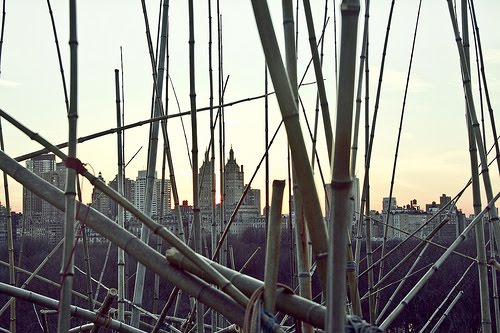
Big Bambu - Installation at the Metropolitan Museum of New York

photo by the Metropolitan Museum of NY


The Metropolitan Museum of New York invited the twin brothers, Doug and Mike Starn for a sculptural colossal installation on the garden roof top.
In an audio interview, they talk about their work:
" We wanted to make a living organism, not really finished, on what it means to be alive, not only on the animal level, but as a city, as a culture, it is always complete but not finished. There are lines and flow of directions while we set it up. But there is no symmetry. We created pathways within just as cities get energy from roads and pathways, we wanted our pathways to feed the installation. It is a lot of fun to walk on the bambu installation, you feel like a kid again. it is incredible with the view of the central park."
An interesting experience, and elevating on many levels: the city, the ground and the interconnections of humans and their surroundings.